

Quality Assured
Just Buy It
- Comparison
- 在线预约
- 预约申请
- 样品申请
- 在线询价

Digital Liquid Density Meter
Digital Liquid Density Meter
RDLD-A,RDLD-B,RDLD-C

Brand:
RUISCI
-
Click to select
- RDLD-A-30,0.01~300g
- RDLD-A-60,0.01~600g
- RDLD-B-30,0.01~300g
- RDLD-B-60,0.01~600g
- RDLD-B-30A,0.005~300g
- RDLD-B-60A,0.005~600g
- RDLD-C-12,0.0001~120g
Inventory
1918
隐藏域元素占位
Overview
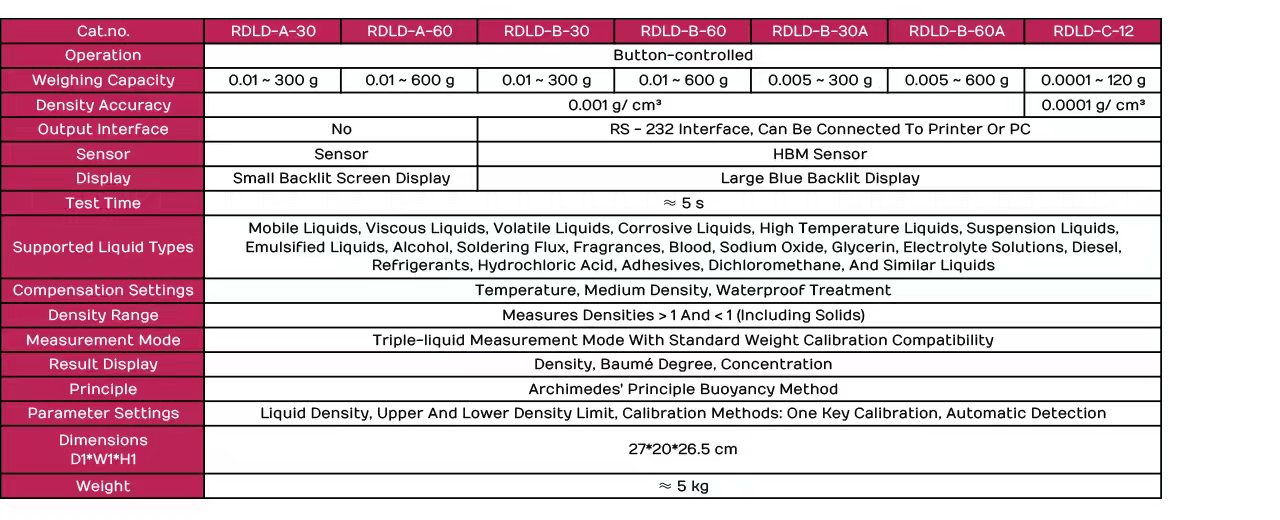
The Digital Liquid Density Meter is a precise instrument based on Archimedes' principle, used for measuring the density of liquids. It features high accuracy, rapid measurement, and easy operation. It is widely applied in industries such as chemical engineering, food processing, and pharmaceuticals for quality control and product development.
Features
1. ARM chip: Fast operation speed and high test accuracy.
2. HBM sensor: Integrated precision high-accuracy weighing unit with low temperature drift, providing consistent reliable results. It is equipped with a high-performance single-chip microprocessor control system and an internal overload protection device, ensuring that the accuracy and stability of the instrument can be effectively protected.
3. Durability: Made of high-quality materials to ensure long-term stable use.
4. Multi-functionality: Can measure multiple parameters.
Technical data
Precautions:
1. Calibration: Regularly calibrate the instrument to ensure the accuracy of measurement results. Use standard substances for verification.
2. Sample Preparation: Ensure the sample is representative, free of bubbles, and thoroughly mixed.
3. Temperature Control: Conduct measurements at a constant temperature to minimize the impact of temperature fluctuations on the results.
4. Cleaning and Maintenance: Clean the sample cell and contact parts before and after measurement to prevent cross-contamination and corrosion.
5. Environmental Conditions: Use the instrument under suitable environmental conditions, avoiding extreme temperatures, humidity, and vibration.
6. Power Management: Use a stable power supply to prevent voltage fluctuations from affecting measurement results.
7. Safety Precautions: Take appropriate safety measures when handling corrosive or toxic liquids.
8. Storage Conditions: When not in use, store the instrument in a dry, clean, and temperature-appropriate environment.
9. Avoid Overloading: Do not exceed the instrument's measurement range to prevent damage to the sensor.
keyword:
- 产品描述
- 概要参数
- 技术参数
-
- Brand: RUISCI
- Commodity name: Digital Liquid Density Meter
- Subtitle: Digital Liquid Density Meter
- Model: RDLD-A,RDLD-B,RDLD-C
- 全部型号: Digital Electronic Automatic Digital Density Meter Liquids Density,Densitometer,Precision Hydrometer With Digital DisplayRDLD-A-30,RDLD-A-60,RDLD-B-30,RDLD-B-60,RDLD-B-30A,RDLD-B-60A,RDLD-C-12
The Digital Liquid Density Meter is a precise instrument based on Archimedes' principle, used for measuring the density of liquids.
The Digital Liquid Density Meter is a precise instrument based on Archimedes' principle, used for measuring the density of liquids. It features high accuracy, rapid measurement, and easy operation. It is widely applied in industries such as chemical engineering, food processing, and pharmaceuticals for quality control and product development.
-
1. ARM chip: Fast operation speed and high test accuracy.
2. HBM sensor: Integrated precision high-accuracy weighing unit with low temperature drift, providing consistent reliable results. It is equipped with a high-performance single-chip microprocessor control system and an internal overload protection device, ensuring that the accuracy and stability of the instrument can be effectively protected.
3. Durability: Made of high-quality materials to ensure long-term stable use.
4. Multi-functionality: Can measure multiple parameters. -
Precautions:
1. Calibration: Regularly calibrate the instrument to ensure the accuracy of measurement results. Use standard substances for verification.
2. Sample Preparation: Ensure the sample is representative, free of bubbles, and thoroughly mixed.
3. Temperature Control: Conduct measurements at a constant temperature to minimize the impact of temperature fluctuations on the results.
4. Cleaning and Maintenance: Clean the sample cell and contact parts before and after measurement to prevent cross-contamination and corrosion.
5. Environmental Conditions: Use the instrument under suitable environmental conditions, avoiding extreme temperatures, humidity, and vibration.
6. Power Management: Use a stable power supply to prevent voltage fluctuations from affecting measurement results.
7. Safety Precautions: Take appropriate safety measures when handling corrosive or toxic liquids.
8. Storage Conditions: When not in use, store the instrument in a dry, clean, and temperature-appropriate environment.
9. Avoid Overloading: Do not exceed the instrument's measurement range to prevent damage to the sensor.
Q and A
There is currently no content to display
Download
There is currently no content to display
Related products
Online consultation

RUISCI provides users with a complete set of certified high-quality products related to laboratory equipments, instruments, analytical methods, chemicals, consumables, and other analytical works.
RUISCI is a RUIANZE company